
Erosion Control and Miscanthus: Planting in Strips
Erosion Control and Miscanthus: Planting in Strips
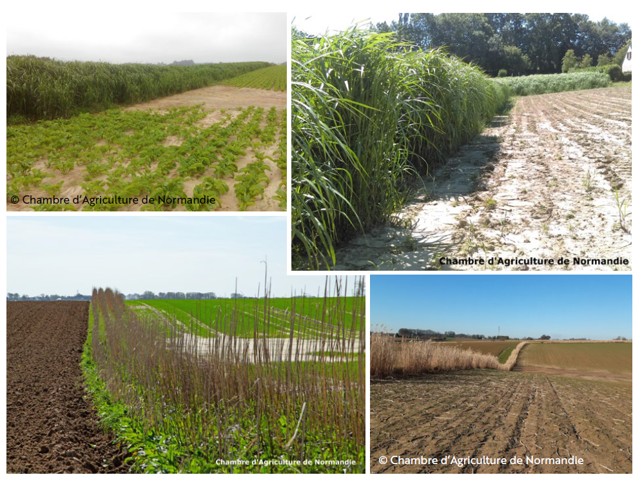
Strips of miscanthus are often used as erosion control measures. Typically 4 to 8 meters wide, these strips of miscanthus slow down water flow and cause soil particles to settle.
This practice of planting lignocellulosic strips (BLC) has become particularly widespread in Seine-Maritime. In this department, the Normandy Chamber of Agriculture provides advice and guidance on long-term initiatives for farmers’ fields. More broadly, new miscanthus plantings take place every year in erosion-prone areas, whether or not they are part of supported programs.
Miscanthus strips: How do they work?
Between 2015 and 2019, in Normandy, GIEE Innobioma and AREAS monitored miscanthus BLCs. The benefits of miscanthus in combating erosion:
- A perennial crop with a well-developed root system that stabilizes the soil
- A crop harvested in early spring, meaning it is still in the ground during summer thunderstorms and in the fall and winter, when rainfall is higher.
By way of comparison, when it comes to erosion control, miscanthus is just as effective as permanent grassland—that is, very effective.
Link to the study results: https://www.areas-asso.fr/wp-content/uploads/2022/01/rapport-innobioma-infiltration-2018-03-18.pdf
Some guidelines for planting miscanthus in strips to control erosion:
- Plant the rows perpendicular to the direction of the water flow
- Strips at least 4 m wide, and ideally 6 m wide: most forage harvesters operate at this width, which is the optimal width for a usable lignocellulosic strip.
- A density of 20,000 rhizomes per hectare and higher-density planting in low-lying areas: if runoff is concentrated, plant the rhizomes more densely in the low-lying areas, and use wider strips than for diffuse runoff.
Miscanthus plantings to combat erosion are taking place throughout France. Some projects are supported by hunting chambers or federations, while others are individual initiatives by farmers.
Mr. Loy's account, from the Somme: